
Haunted Houses
On dolls, the Catholic Church, and things that go bump in the night

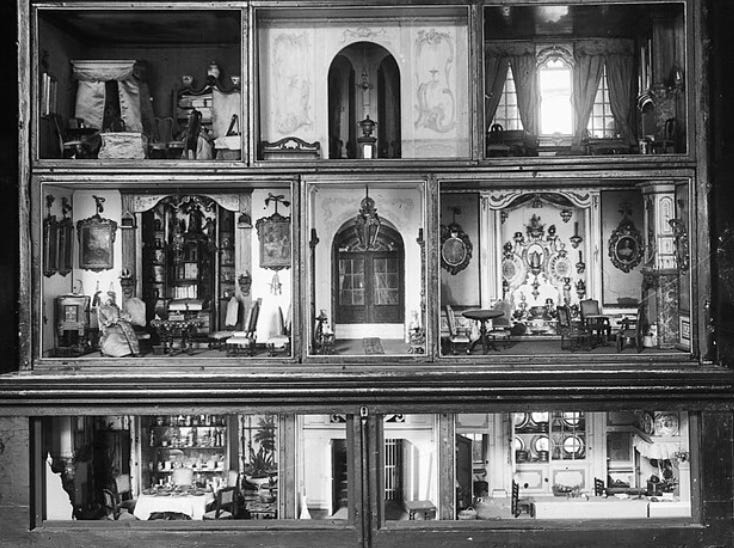
Image: Wiki Commons
The first time I gazed upon a dollhouse, I knew that the figures inside were alive. I must have been five years old when I saw that glorious, gabled Victorian in my friend’s bedroom. Three stories with a fuchsia façade, central staircase, and furnishings eerily true-to-life, only miniaturized. The doll family stood frozen in place, but I was sure that was only because of an onlooker.
Not only did one of my picture books portray toys coming to life while humans slept, but Catholicism made the world enchanted. Mine was a realm of statues and saints, incense and tongue-speaking. Spirits lurked everywhere.
Before long, my wonderment at the secret life of dolls transposed into an intense desire to humiliate them. It was no longer about what they did when no one was looking, but what I could do with only my playmate to see. To my friend’s giggles, I spanked them, undressed them, made them kiss and bump up against one another.
Dolls promise little girls that they can be on the outside—that they can look into the haunted house, rather than dwell in it. Touch, rather than be touched. Seeming to intuit this, a segregationist once stitched fabric dolls, stuffed them with cotton, and marketed them to white families for their young females to beat, throw, and hang on the clothesline. Those limp, unfeeling Raggedy Anns inducted a whole generation into the violence of Jim Crow. They did less to prepare their owners for their own objectification.
But once you believe in something’s existence, you can’t relegate it to oblivion—not totally, anyway. In their silence, dolls continue to speak. They want something, even simply to remain in the world of the living. On a guest bed, perhaps, or in a corner chair. “Take me with you,” they say, every time the moving boxes come out.
Other spirits have their own ways of insisting on existence. Those saints depicted on placards or staring down from the stained glass of smoke-filled cathedrals—they find me when I’m alone or nodding off to sleep. They make me wonder if I had it right the first time and a whole world teems beneath the surface of human perception. They make me wonder if the dead are alive, somehow, and none of us are the sovereigns we think we are.
This SubStack is about things that are both there and not-there. Gone but not yet past. Things that appear, then slip away before anyone can possess or understand them. Things that possess us, permitting no rest.
I was formed in the Catholic Church, an institution whose Gothicity simultaneously entranced and petrified—and whose gargoyles, when I tried to leave, hopped off their pedestals and chased me right out the door. But I believe that we all move through haunted houses, whether we realize it or not. And that we are ourselves haunted houses, though few are willing to wonder what that means.
Because we tend to encounter ghosts on their terms, not ours, ghost-hunting takes the form of vigilance. To hunt for ghosts is to be still, to wait, to return.
To what must you return?
Fascinated by this idea: “that we are ourselves haunted houses, though few are willing to wonder what that means.” Looking forward to your further explorations!
WOW Audrey! This is beautiful and inviting.